Dr. Julio Villa-Palomino is a medical and sociocultural anthropologist whose research explores the intersections of mental health, care, and community in Latin America. Villa-Palomino earned his PhD in Anthropology from the University of North Carolina at Chapel Hill, an M.A. in Latin American Studies from the University of Florida, and a B.A. in Sociology from Pontificia Universidad Católica del Perú. He joined the Anthropology department at the University of Michigan in the Fall of 2024 as an Assistant Professor and Michigan Society Fellow. His work focuses on the ethical and political dimensions of psychiatric expertise and care in Perú, with particular attention to how individuals, families, and institutions navigate the transition from hospital-based to community-based mental health systems. His broader research interests include psychological anthropology, disability and mental health activism, and the afterlives of psychiatric institutions in the region.
As part of his teaching at U-M, Villa-Palomino brings these perspectives into the classroom. For example, in the Winter 2025 semester, he taught ANTHRCUL 298: Anthropology of Mental Health, a course that examined questions such as the ethics of diagnosis, the line between care and coercion, and cross-cultural understandings of witchcraft and conditions like schizophrenia, depression, and anxiety. These themes encouraged students to think critically about mental health through anthropological research and case studies. Class sessions were held twice a week: in one session, Villa-Palomino led a discussion on the assigned readings, fostering thoughtful dialogue; in the other, a pair of students presented on the readings and facilitated a class discussion. This structure gave students space to ask questions, engage with the material more deeply, and share their own perspectives on mental health. “It's a course about unique experiences rather than mental health as an abnormal phenomenon. As a class we aren’t necessarily trying to figure out what’s objective or subjective, but rather determine what are the problems that mental health and wellbeing generate for us as human beings. Anthropology is about going beyond binary such as modern-traditional, good-bad, right-wrong,” said Villa-Palomino.
While designing the course, Villa-Palomino aimed to provide students with a strong foundation in anthropological approaches to mental health. He carefully selected readings that introduced key theoretical perspectives while also highlighting diverse stories, practices, and experiences from around the world. It was important to him that students not only engaged with academic research, but also encountered voices and contexts that challenge conventional understandings of mental health. “There are things in the ways we view and talk about mental health that haven't changed for centuries. In class, my goal is to challenge those perceptions a little bit through conversation and engagement with global case studies. My priority is to make the classroom welcoming and a place for respectful discussion,” said Villa-Palomino.
Beyond engaging with the course’s academic materials, Villa-Palomino encouraged students to practice taking care of their own mental wellbeing, whatever that may look like. In the first few minutes of class, students were often invited to share “small wins” from their week or check-in with peers sitting nearby. “Students are under a lot of pressure, so it’s really important to me that my class is a space for students to feel comfortable to connect with each other and show compassion. I’m big on extending grace to students because everyone has shifting priorities and abilities,” said Villa-Palomino.
A central theme of the course was equity. Students were encouraged to reflect on what equity means in the context of mental health treatment and research. The course emphasized that experiences of mental health and diagnoses vary widely from person to person, shaped by a complex web of ethical, cultural, political, and social factors. Two individuals may live with the same condition yet experience it in profoundly different ways, whether that be because of access to treatment, categories of what is considered a pathological condition, among others. To highlight this complexity, Villa-Palomino intentionally wove diverse cultural perspectives from South Asia, East Asia, and Latin America into the course material throughout the semester.
Essential questions students explore include: How do we inhabit the world with a mental health difference? What can be done to de-stigmatize mental illness? What socioeconomic processes inform the lived experience of people with mental health problems? The goals are: 1) to develop a cross-cultural understanding of mental health, 2) to learn how anthropology and related social sciences explore mental health, and 3) to critically assess how culture and institutions shape our understanding of mental health and illness. Students are introduced to critical medical anthropology, which differs from traditional biomedical models in that it forefronts the complex historical, social, political, and economic conditions that affect the lived experience of health, and particularly mental health in this class. The challenge here is helping global health practitioners, who often want a clear line from knowledge → intervention → measurable improvement in health, to see that critical medical anthropology is not abstract, but rather essential for making interventions effective, humane, and impactful. Using susto as an example works beautifully because it bridges cultural meaning, structural vulnerability, and embodied experience.
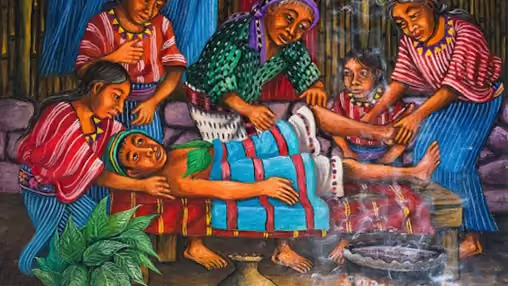
In Dr. Villa-Palomino’s class, students explored how critical medical anthropology deepens our understanding of illness and can inform better global health responses. Using the example of susto, often described in Latin America as “fright sickness” or “soul loss,” students learned how health cannot be separated from cultural meaning. While the symptoms of susto may resemble biomedical categories such as depression or gastrointestinal illness, communities interpret and respond to it in ways rooted in spiritual, emotional, and social contexts. Ethnographic research shows that susto often reflects the embodied consequences of violence, poverty, malnutrition, or inequality, illustrating how social conditions can literally enter the body. A strictly biomedical response might prescribe antidepressants or nutritional supplements, but if the community understands the illness as a spiritual loss, then healing rituals, emotional support, or other interventions may be just as or more effective. Critical medical anthropology equips practitioners to integrate multiple approaches to improving health, leading to strategies that resonate with communities, build trust, and deliver real uptake and better outcomes. For students, the lesson is clear: impact in global health must include dignity and culturally meaningful healing, ultimately helping people live not only longer, but better lives.
Since joining the University of Michigan, Villa-Palomino has found it deeply inspiring to be part of a community where so many students, faculty, and researchers are committed to tackling some of the world’s most pressing social and health challenges. Being surrounded by individuals who are passionate about making a meaningful impact has reinforced his own dedication to advancing equity through research, teaching, and collaboration. “I feel supported by the university and my colleagues which in turn helps me to better support my students and other faculty,” said Villa-Palomino.
Looking forward, Villa-Palomino envisions his research evolving to contribute to both academia and activist engagement. He’s committed to advocating for more equitable mental health systems in Latin America and hopes to amplify the voices of the communities he works with, such as youth and caregivers in Peru, by facilitating their presence in policy spaces and public discourse. He’s especially interested in expanding transnational collaborations across the Southern Cone and beyond, connecting researchers, activists, and practitioners to reimagine mental health care across borders. For Villa-Palomino, the future of his research is not only about producing knowledge but also about leveraging that knowledge to build networks, elevate marginalized voices, and push toward greater equity in mental health provision.
Dr. Villa-Palomino will teach ANTHRCUL 298: Anthropology of Mental Health again in the Winter 2026 term. Contact him at [email protected]
About the authors:
Ava Renfer, BA in Communication & Media, Minor in French, Class of 2025
Ava served as the CGHE Communications Assistant from Fall 2022 to Summer 2025. Ava is a marketing and sales expert and a passionate community-builder who finds joy in helping others thrive and succeed.
Ayleen Correa, PhD Candidate in Anthropology and History
Ayleen has served as the CGHE Outreach Program Assistant since Fall 2022. She is in her 5th year in the joint doctoral program in anthropology and history at the University of Michigan. Her work centers on envisioning community sustainability in the face of historical and ongoing forms of violence and care practices.