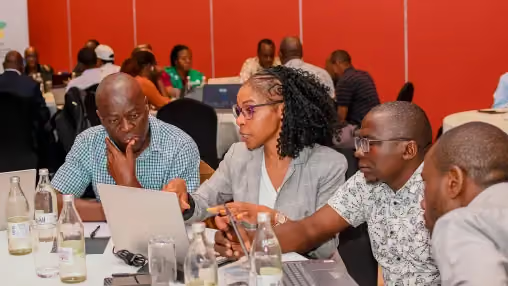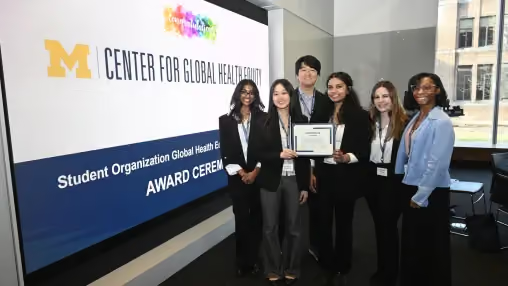
The Center for Global Health Equity at the University of Michigan has awarded more than $15,000 in funding to five student organizations following its second annual Student Organization Global Health Equity Challenge pitch competition, held March 28. The event marked the culmination of a months-long program designed to support students in developing equitable, sustainable global health projects in partnership with communities abroad.
This year’s top award of $5,000 was granted to M-HEAL The Initiative for their work reducing infant hypothermia in low-resource settings. Two teams — Global Health Alliance and NAAMA NextGen — tied for second place, each receiving $3,000 in support. Project MESA and the Neonatal Asphyxia Project tied for third and earned $2,000 each.
Each student team was evaluated by an interdisciplinary panel of judges based on the strength of their proposed partnerships, clarity of project design, and alignment with the center’s values of equity, co-design, and impact. All finalists will receive continued mentorship and institutional support from the center throughout the implementation of their projects, which are set to begin April 1 and run through April 2026.
“Our goal is to not only fund impactful ideas, but to cultivate leaders in global health,” said Akbar K. Waljee, MD, the Leslie D. Yamada and Tachi Yamada MD director of the Center for Global Health Equity at the University of Michigan (U-M). “Through training, mentorship, and access to a global network of faculty and partners, we help students take their ideas further and ensure their work reflects true partnership and sustainability.”
Fourteen student groups embarked on the competition journey by participating in an introductory workshop held in December 2024. The workshop was co-facilitated by Cheryl Moyer, PhD, MPH, a professor in the Department of Learning Health Sciences at the U-M Medical School and a center member, together with Alana Rodriguez, the center’s student project manager.
“The center’s investment in student organizations goes beyond a single event,” said Rodriguez. “We offer structure, oversight, and community — all grounded in a shared commitment to equitable partnerships and locally led solutions.”
Ten teams submitted proposals in January, and five were selected to advance to a finalist phase that included intensive feedback and preparation with center staff and U-M faculty members, including Gurpreet Rana, global health coordinator at U-M’s Taubman Health Sciences Library.
Anne Perigo, associate director of student programs at the Zell Lurie Institute, hosted a tailored “How to Pitch” workshop in February, helping students strengthen their delivery. Finalists also received mentorship from University of Michigan faculty experts in environmental health, global women’s health, neonatal care, neurology, and global nursing.
Awarded projects
This event is part of a broader effort by the center to equip the next generation of global health leaders with the skills, support, and ethical framework to foster meaningful, long-term change in global health.
Acknowledgements
The Center for Global Health Equity is grateful to the many faculty, staff, and community members who generously volunteered their time to support this year’s competition — from leading workshops and mentoring students to serving as judges.
Pitch Preparation Mentors and Workshop Facilitators
Judging Panel