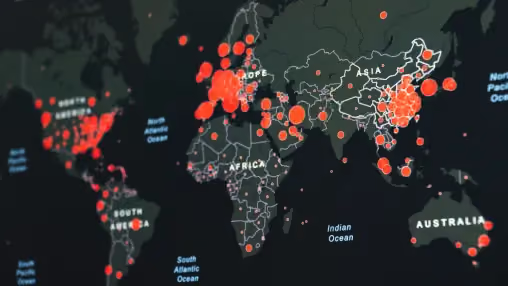
As we advance discussions around strategies for the new Center for Global Health Equity, it is impossible to ignore the broader context in which our work is taking place. COVID-19 continues to present us with the largest global health challenge since HIV. As of this writing, we are closing in on 50 million cases and 1.25 million deaths worldwide, with trends in too many countries pointing in the wrong direction, ours included.
A global problem demands an international approach, and with researchers across the university engaged in meaningful collaborations all over the world, the University of Michigan is positioned to play a leading role. Increasingly, Michigan experts are being called on to provide input and advice about health and care structures in low- and middle-income countries. Professor Bhramar Mukerjee, chair of the department of Biostatistics in the School of Public Health and co-lead of our Center’s Data Science Challenge Group, has garnered international attention for her important work modeling COVID-19 in India.
Faculty and patients alike at Michigan Medicine benefitted from our strong relationships in China following the exchange of information of COVID-19 care best practices, and we’ve recently launched a joint project with colleagues in Beijing to better facilitate the study of disease.
Two weeks ago, several of us were invited by the US Ambassador to Bangladesh to participate in a virtual seminar with leadership in Dhaka. The event focused on the potential creation of a virtual mentoring program between the University of Michigan and the nation’s academic institutions for COVID-19 case management.
These are just a few examples of the myriad ways our institution is rising to the global health challenge presented by the ongoing pandemic. Unfortunately, this is unlikely to be an anomaly. Climate change, demographic shifts, population growth, and other factors mean that we will almost certainly face more pandemics in the future. How should we approach this new era?
While we are yet in the early stages, I firmly believe our Center—with our multidisciplinary, synergistic approach—is well positioned to enable faculty, staff, departments, and schools across the university to confront these unprecedented challenges alongside our partners abroad.
I look forward to hearing from you regarding ideas and strategies on how our center can help bring people together both to confront our current threats and to reduce the impact of future pandemics.
Joseph C. Kolars, MD, MACP
Director, Center for Global Health Equity
Senior Associate Dean and Professor of Medicine
Josiah Macy Jr. Professor of Health Professions Education,
U-M Medical School
Professor of Health Management and Policy,
U-M School of Public Health