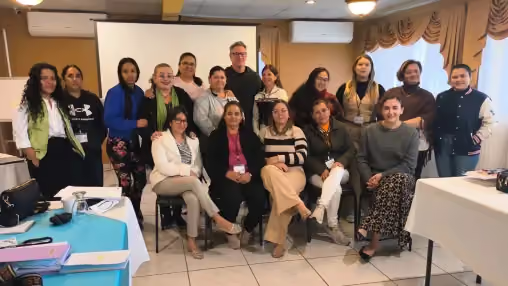
By the time Aalaynah Nathoo—an undergraduate at the University of Michigan— stood in front of a classroom of Kenyan high school girls leading a panel on women in STEM, something had shifted.
“They asked me what it’s like to be a woman studying science in the U.S.,” said Nathoo, recalling the moment months later from her home in Ann Arbor. “We ended up talking about everything—dreams, science, pressure, self-doubt. It was the most human, unscripted thing I’ve ever done in an academic setting.”
That moment—a casual lunch after a volunteer-led workshop—captured the essence of her six-month internship at Aga Khan University’s Institute for Human Development (IHD) in Nairobi. Nathoo, a University of Michigan student on a gap year, arrived in Kenya hoping to gain research experience. She left with something far less quantifiable and far more profound: a sense of how research is driven by relationships, partnership, and collaboration.
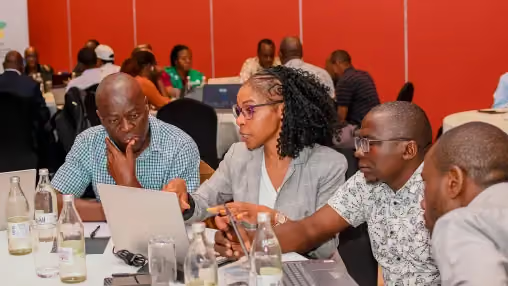
Her days at IHD were rich with technical training. She joined a systematic review team studying how stigma affects children with sickle cell disease and worked with doctoral student Joan Mutahi to develop a new conceptual model on the intersection of mental health and chronic illness. With Ronald Kipkirui, PhD, she attended weekly neuroscience seminars and began learning to analyze brain scans using software like MATLAB and SPM—skills she would later apply at a neuroscience conference in South Africa.
But the real education happened in the spaces between. In the long car rides to rural sites where mothers learned to support children with autism. In the bustling pediatric wards, she shadowed. In the camaraderie of weekend volunteer events, where children turned science into games.
“There were days when I was reading peer-reviewed papers, and then days when I was holding hands with mothers telling their stories in Swahili,” Nathoo said. “Being immersed in that rhythm—you start to see that knowledge isn’t just in the research. It’s in the relationships. It’s in the way people adapt, teach, care.”
Her hosts at AKU seemed to understand that instinctively. Professor Amina Abubakar, director of IHD, helped guide her early goals and created space for Nathoo to lead. “They trusted me,” Nathoo said. “Even as a student, they let me contribute. They let me try.”
She did more than try. In late summer, Nathoo and fellow intern Neha pitched an original research project to leadership at her host organization, hoping to find a principal investigator to mentor them. “We were nervous,” Nathoo remembered. “But we showed up with a protocol, a proposal—and he said yes. That was the moment I realized: I can do this. I can own my ideas.”
The team received ethics approval just as Nathoo was preparing to return home, and although they ultimately decided not to proceed due to the logistical challenges of conducting the study remotely, the process itself was a formative one. “It was validating to be taken seriously at every step,” she said. “Even though the project didn’t move forward, the experience gave me a new kind of confidence.”
It’s that shift—from student to engaged contributor—that the University of Michigan’s Center for Global Health Equity is working to foster. Through immersive, cross-institutional experiences like Nathoo’s, the Center encourages early-career scholars to see themselves as active participants in shaping global health research. By emphasizing collaboration over individualism and investing in partnerships with institutions like Aga Khan University, the center is helping students build the habits of shared inquiry and mutual learning that global health work truly requires.
Learn more about our student programs
For Nathoo, that future looks less like a clear path and more like a set of values: partnership, empathy, and action.
“This internship changed everything,” she said. “I don’t just want to study health. I want to create something—with people, not just about them. That’s the kind of physician and researcher I want to become.”
Nathoo didn’t leave Kenya with all the answers. But she returned with something more valuable: the confidence to ask better questions, and the belief that the most meaningful solutions are the ones we build patiently, and together.
“I don’t just want to study health. I want to create something—with people, not just about them. That’s the kind of physician and researcher I want to become.”