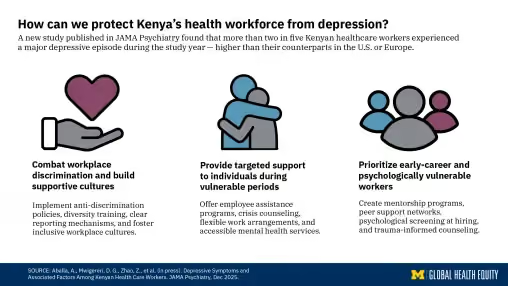
A groundbreaking year-long study of healthcare workers in Nairobi, Kenya, has revealed alarming levels of depression, with more than two in five participants meeting diagnostic thresholds for major depression at some point during the study period. The findings, published in JAMA Psychiatry, highlight an urgent mental health crisis among medical professionals in Kenya and point to the need for culturally tailored interventions across low- and middle-income countries.
The research, led by Andrew Aballa and an international team of researchers, tracked 514 doctors, nurses, and other healthcare workers from five Nairobi hospitals over twelve months. Using the validated Patient Health Questionnaire (PHQ-9), the study found that 43.1% of participants experienced major depression at one or more assessment points, with 16.9% and 5.5% suffering from moderately severe and severe depression, respectively.
Perhaps most striking is how these rates compare to healthcare workers elsewhere. The prevalence among Kenyan healthcare professionals notably exceeds that reported among their counterparts in Europe and North America, as well as the general Kenyan population.
The study identified several significant predictors of depressive symptoms. Personal factors played a major role: higher neuroticism, not being in a committed relationship, and a difficult early family environment all increased vulnerability to depression. Among workplace factors, discrimination and stressful life events emerged as particularly potent contributors to depressive symptoms.
Interestingly, the Kenyan experience diverged from findings in similar US studies. Unlike their American counterparts, work hours and medical errors were not significantly linked to depression among Kenyan healthcare workers, suggesting that the drivers of mental health struggles may vary meaningfully across different healthcare contexts and cultures.
The research emerged from the UZIMA-DS (Utilizing Health Information for Meaningful Impact in East Africa through Data Science) initiative, supported by the Center for Global Health Equity at the University of Michigan. The UZIMA-DS Research Hub represents a state-of-the-art platform dedicated to applying advanced data science, artificial intelligence, and machine learning methodologies to improve health outcomes for young Africans.
The hub's focus on youth reflects a compelling demographic reality: Africa is the world's youngest continent, with 60% of its population under age 25. This period from early life to young adulthood represents a critical window where biological, environmental, and psychosocial factors can significantly impact long-term health—or "uzima," the Swahili word for health or well-being. UZIMA-DS aims to develop early warning systems for maternal, newborn, child, and mental health by leveraging the enormous volumes of data now being collected across eastern Africa.
The healthcare worker study adapted the well-established Intern Health Study protocol for the Kenyan context, with participants completing surveys at enrollment and quarterly intervals. Researchers used sophisticated weighting strategies to reduce attrition bias and employed Generalized Estimating Equations to explore the complex interplay of demographic, personality, and workplace factors.
The study's authors acknowledge some limitations, including potential underreporting of symptoms and limited generalizability beyond nurses and physicians in Nairobi. Nevertheless, the findings underscore an urgent need for mental health support systems tailored to the specific challenges facing healthcare workers in low- and middle-income countries.
The research points to several potential intervention targets: addressing workplace discrimination, providing support during stressful life events, and offering resources for those with difficult family backgrounds or high neuroticism.
As healthcare systems across Africa continue to face mounting pressures, the mental health of those delivering care cannot be overlooked. This study represents an important step toward understanding and ultimately addressing the mental health crisis among the continent's healthcare workforce—a crisis that, if left unaddressed, threatens both the well-being of healthcare workers themselves and the quality of care they can provide to their communities.
The healthcare worker study represents one of several investigations emerging from the UZIMA-DS initiative. The research hub is also examining maternal mental health in rural Kenya, using machine learning approaches to identify key predictors of depression and anxiety among mothers of young infants. This multi-pronged approach—studying both healthcare providers and vulnerable patient populations—reflects the hub's comprehensive strategy to improve mental health outcomes across East Africa.
The research was supported by the National Institutes of Health through a collaborative award involving the Office of the Director, the National Institute of Biomedical Imaging and Bioengineering, the National Institute of Mental Health, and the Fogarty International Center.
Andrew Aballa, MSc – Institute for Human Development, Aga Khan University, Nairobi, Kenya
Dorcas G. Mwigereri, MSc – Department of Population Health, Aga Khan University, Nairobi, Kenya
Zhuo Zhao, MS – Michigan Neuroscience Institute, University of Michigan Medical School, Ann Arbor, Michigan
Willie Njoroge, MSc – Brain and Mind Institute, Aga Khan University, Nairobi, Kenya
Linda Khakali, MA – Brain and Mind Institute, Aga Khan University, Nairobi, Kenya
Rachel Maina, PhD – Brain and Mind Institute, Aga Khan University, Nairobi, Kenya
David Andai, MBChB – Brain and Mind Institute, Aga Khan University, Nairobi, Kenya
James Orwa, PhD – Department of Population Health, Aga Khan University, Nairobi, Kenya
Amos Bunde, MSc – Computing and Data Innovation Office, Aga Khan University, Nairobi, Kenya
Eileen M. Weinheimer-Haus, PhD – Center for Global Health Equity, University of Michigan, Ann Arbor, Michigan; Department of Learning Health Sciences, University of Michigan Medical School, Ann Arbor, Michigan; Michigan Integrated Center for Health Analytics and Medical Prediction (MiCHAMP), University of Michigan, Ann Arbor, Michigan
Jessica Baker, MS – Department of Learning Health Sciences, University of Michigan Medical School, Ann Arbor, Michigan
Lukoye Atwoli, MD, PhD – Brain and Mind Institute, Aga Khan University, Nairobi, Kenya; Department of Medicine, Medical College East Africa, Aga Khan University, Nairobi, Kenya
Srijan Sen, MD, PhD – Michigan Neuroscience Institute, University of Michigan Medical School, Ann Arbor, Michigan
Akbar K. Waljee, MD, MSc – Center for Global Health Equity, University of Michigan, Ann Arbor, Michigan; Department of Learning Health Sciences, University of Michigan Medical School, Ann Arbor, Michigan; Michigan Integrated Center for Health Analytics and Medical Prediction (MiCHAMP), University of Michigan, Ann Arbor, Michigan
Anthony K. Ngugi, PhD – Department of Population Health, Aga Khan University, Nairobi, Kenya
Amina Abubakar, PhD – Institute for Human Development, Aga Khan University, Nairobi, Kenya; Neurosciences Unit, Kenya Medical Research Institute, Wellcome Trust Research Programme, Kilifi, Kenya
Zhenke Wu, PhD – Department of Biostatistics, University of Michigan, Ann Arbor, Michigan
Zul Merali, PhD – Brain and Mind Institute, Aga Khan University, Nairobi, Kenya
Elena Frank, PhD – Michigan Neuroscience Institute, University of Michigan Medical School, Ann Arbor, Michigan