The University of Michigan's 'Look to Michigan' campaign challenges us to demonstrate how our research, partnerships, and innovation create measurable impact on humanity's greatest challenges. For global health equity, the answer lies in three strategic priorities that define what it means to look to Michigan for solutions.

In an era of funding uncertainty and shifting global health priorities, protecting early and mid-career faculty isn't just good practice—it's a strategic imperative. These researchers are developing the bold ideas that will define the next generation of global health solutions, but they need protected time, mentorship infrastructure, and flexible seed funding to take calculated risks.
When research partners look to Michigan, they find faculty who have the institutional support to pursue high-impact, collaborative work. In 2025, this approach generated $28.9 million in new external funding and three major NIH awards—proof that investing in faculty innovation creates the conditions for breakthrough research.

AI-enabled solutions for cancer and non-communicable diseases represent Michigan's distinctive advantage in global health innovation. When diagnostic infrastructure is limited, when pathology results take seven weeks instead of seven days, when cancer care gaps threaten lives—this is where Michigan's computational expertise meets urgent human need.
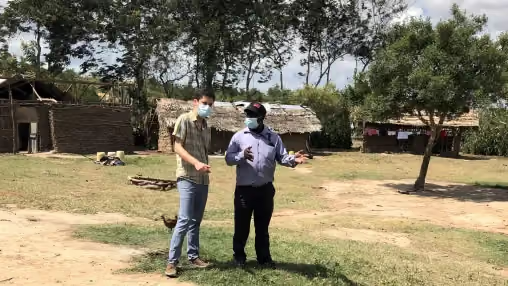
Our partnerships in Kenya demonstrate what's possible: AI-powered tools with the potential to reduce pathology diagnosis time from weeks to seconds, improving treatment outcomes for patients who can't wait. This isn't theoretical research—it's deployed technology changing clinical practice in resource-limited settings.

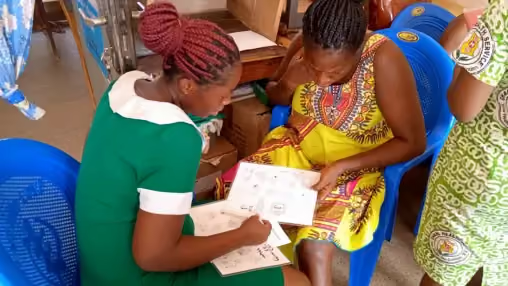
The most distinctive aspect of looking to Michigan for global health solutions is our model of trust-based collaboration. We don't extract data or parachute in with predetermined solutions. We match Michigan faculty with international partners who bring local expertise, co-develop research questions that matter to communities, and build sustainable capacity that outlasts any individual project.
This approach attracts partners who want collaborators, not funders. It generates research that changes policy because it's grounded in local realities. And it creates the kind of reciprocal learning that strengthens both Michigan's scholarship and our partners' health systems.
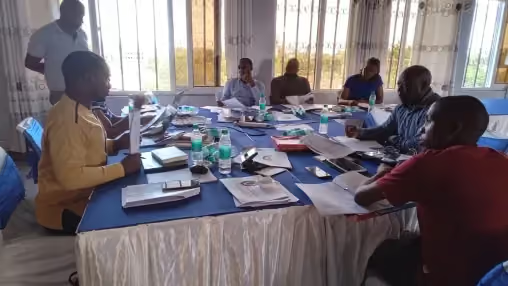
Global health equity isn't achieved by individuals working in isolation—it's built through networks of researchers, clinicians, students, and partners who see collaboration as the path forward. In 2025, our community grew to 489 members, forming 49 interdisciplinary research teams across 29 U-M units, that brought together at least three disciplines to tackle complex health challenges.
Our country platforms bring together U-M researchers working in the same regions, fostering sustained collaboration that leads to deeper partnerships and more impactful research. Faculty learn from each other's successes and challenges, connect with potential collaborators, and ensure their work aligns with local priorities.
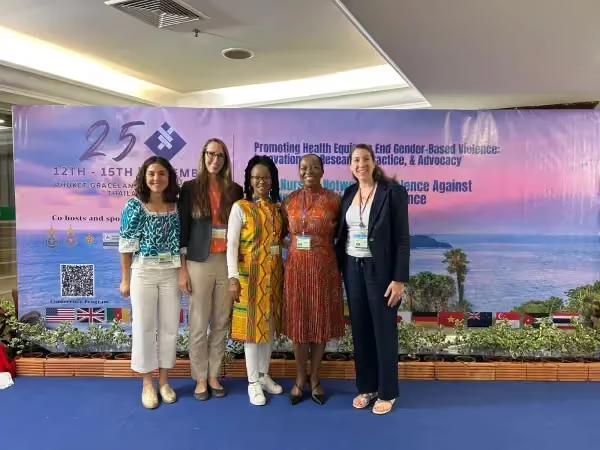

Despite a rapidly shifting funding landscape, center faculty members secured multiple major research awards in 2025 through partnerships spanning Kenya, Brazil, India, and other global contexts—a testament to both the strength of collaborative research design and the behind-the-scenes infrastructure that helped forge these connections. Through seed funding to test ideas with international partners, ongoing mentorship from senior researchers, and strategic matchmaking with institutions like Aga Khan University, the center provided the scaffolding that turns local insights into fundable global research.
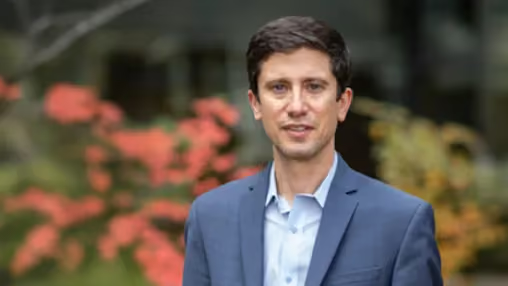
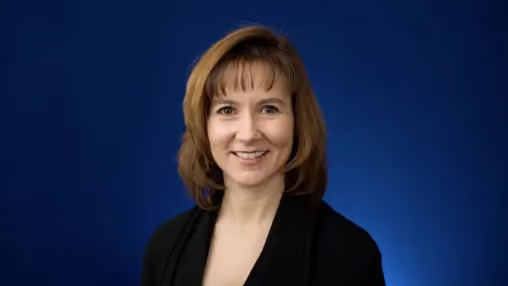
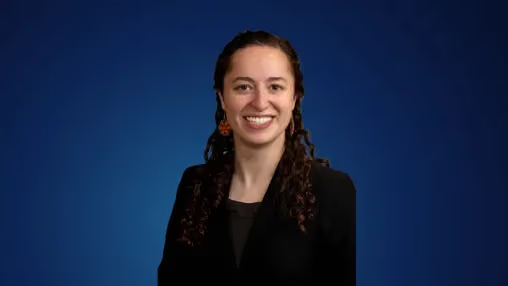
The world's most pressing health challenges demand researchers who can navigate complex funding landscapes, build sustainable partnerships, and translate discoveries into impact. To cultivate these leaders at U-M, the center has built comprehensive infrastructure that supports faculty at every career stage—from protected research time and flexible seed funding to formalized mentorship and hands-on grant development support. In 2025, the center formalized this commitment by appointing three associate directors, amplifying early and mid-career faculty voices in shaping the center's direction. These roles provide protected time for leadership development beyond traditional academic metrics, enabling faculty to drive strategic initiatives, mentor peers, and build skills in partnership development and program design.